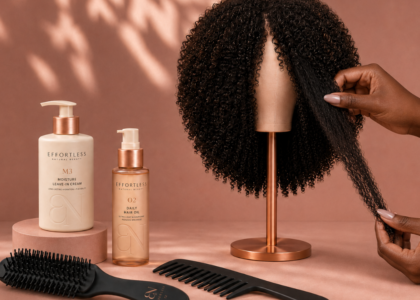


Step into Our Lab
For more than seventy years, the published scientific record has paid remarkably limited attention to the hair and scalp of people of African ancestry.
A 2024 review of the literature identified only 629 relevant publications worldwide between 1953 and 2023. Of those, just 74 came from sub-Saharan Africa—the region most directly connected to many of the hair structures, climates, ingredients and care traditions under discussion.
That does not mean African and diasporic women lacked knowledge about their hair.
It means much of that knowledge was developed somewhere other than the laboratory.
It lived in homes, salons and communities. It travelled through grandmothers, mothers, braiders, stylists, bloggers and creators. It crossed the Atlantic and continued evolving through Black American hair culture, Caribbean practice, African traditions and the natural-hair movement.
At Effortless Natural, science-based means bringing those bodies of knowledge together—and being disciplined about the difference between tradition, observation and verified evidence.
Hair science did not begin with us
Human hair has been examined scientifically for nearly two centuries. Researchers were classifying hair-shaft cross-sections by the 1850s, and microscopy became increasingly important during the late nineteenth and early twentieth centuries. Much of this early work came through anthropology and forensic science rather than the practical study of how women cleanse, condition, style and preserve their hair.
Modern hair science now studies the fibre as a complex biological material: its cuticle, cortex, keratin structure, diameter, tensile strength, response to humidity and reaction to chemical or mechanical stress. Hair can withstand substantial force, but its behaviour changes with moisture, temperature, handling and structural form.
Yet the research has not developed evenly.
Scientific literature specifically addressing Black women’s routines, products and styling practices remains limited. A 2025 clinical review noted that dermatological recommendations are still constrained for Black women who wear natural textures, braids, wigs, weaves, extensions, locs or chemically and thermally altered styles.
Research capacity within Africa is newer still. Annual African hair and skin workshops began in 2004; dedicated African research grants followed in 2013; and the African Society of Dermatology and Venereology was registered in 2015.
So when people with textured hair feel that they have spent decades experimenting for themselves, that feeling has a scientific basis: the formal evidence has often arrived later than the lived knowledge.
Why texture changes the question
All human hair shares a common fundamental architecture. But hair fibres differ in curvature, cross-sectional shape, diameter variation, density and mechanical behaviour.
Afro-textured hair commonly has pronounced curvature and greater variation along the shaft. Sebum also travels less evenly along a curved fibre than along a straighter one. Combined with repeated bending points, friction, heat, tension and chemical processing, this can increase susceptibility to dryness, knotting and breakage.
That does not make textured hair defective.
It makes it scientifically specific.
A formula designed around straight hair cannot automatically be assumed to perform identically on tight curls and coils. The cleanser, conditioning system, oil profile, slip, viscosity, deposition, application method and interaction with styling practices all matter.
This is why our starting point is not the so-called universal consumer.
Our starting point is the person the conventional product-development process has most often expected to adapt.
Design from Complexity Outward
Our thesis is simple:
When a system is designed to perform for the textures with the most complex moisture, detangling and breakage considerations, the knowledge gained can improve products across the texture spectrum.
This is not a hierarchy of hair types. Curly and coily hair are not better, worse or more evolved than straight and wavy hair.
They simply give formulators more variables to solve simultaneously.
Can the product cleanse without creating unnecessary roughness?
Can it provide enough slip for detangling?
Can it support flexibility without leaving every texture heavily coated?
Can it work across different densities, porosities and styling routines?
Can it respect the scalp as well as the fibre?
Designing from those questions outward creates a more thoughtful system for everyone.
This principle extends beyond haircare. Products, services and institutions often become more functional when they are designed around people who were previously treated as exceptions. What serves the more demanding use case can frequently be adapted for the less demanding one; the reverse is not always true.
Fourteen Years Before the Formula
Our founding team has worked within beauty and haircare since 2012.
That period spans the blogger era, the rise of natural-hair YouTube, the expansion of textured-hair product aisles, the product-junkie era and the current movement toward more ingredient-conscious and evidence-conscious care.
It has also involved fourteen years of observation:
What makes detangling easier?
Which routines become too complicated to sustain?
Why do products appear effective for one person and ineffective for another?
What causes buildup?
What creates temporary shine without improving manageability?
Which traditions are supported by emerging evidence—and which claims have simply been repeated often enough to sound scientific?
Community knowledge is not a substitute for controlled research. But it can identify the right questions for science to investigate.
That is the bridge we are building.
From African Knowledge to Formulation Science
Africa contains an extraordinary botanical library, much of which has been used in food, skin, scalp and hair practices for generations.
Our ingredient research has included materials such as:
- Moringa oleifera (moringa)
- Adansonia digitata (baobab)
- Hibiscus sabdariffa (hibiscus)
- Aloe vera (aloe)
- Ricinus communis (castor)
- Sclerocarya birrea (marula)
- Trichilia emetica (mafura)
- Citrullus lanatus (Kalahari melon)
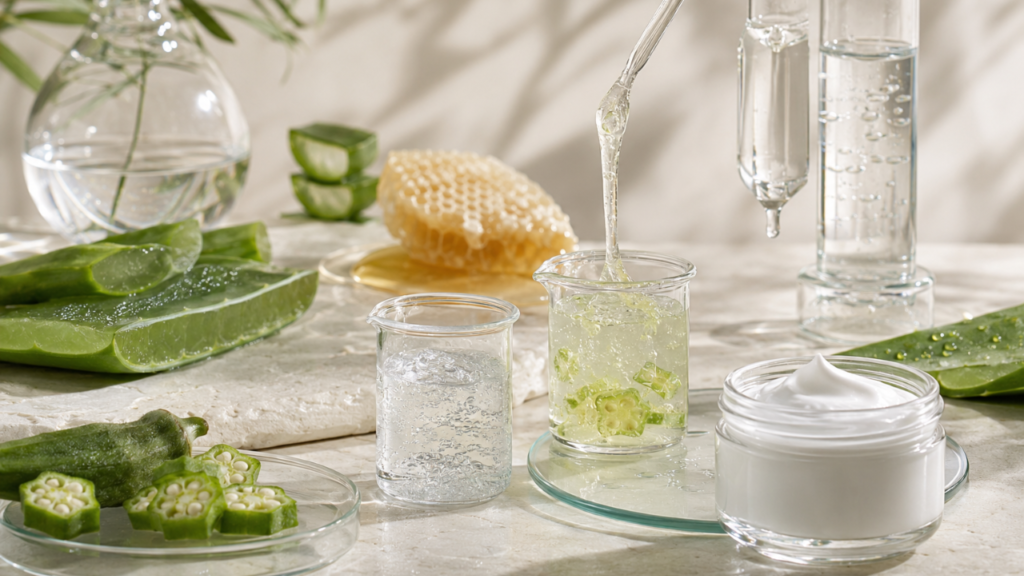
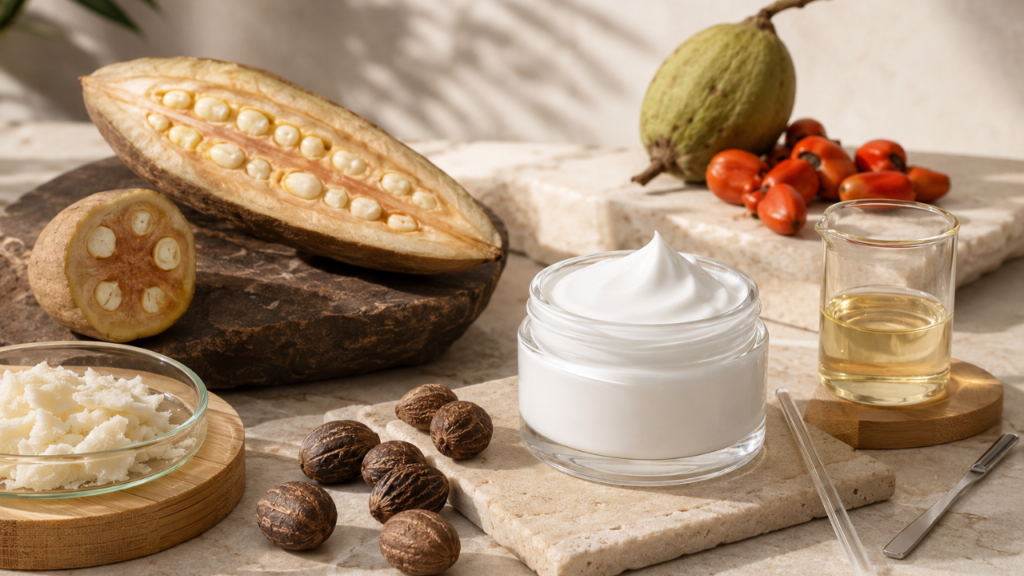
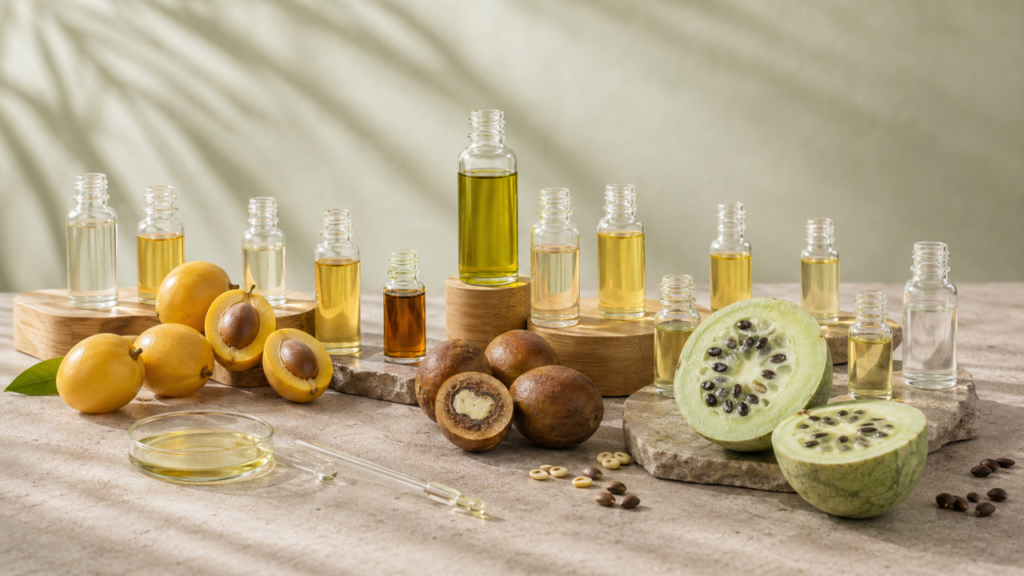
In our lab, a plant’s value depends on factors including:
- the species and plant part;
- where and how it was grown;
- extraction and processing;
- fatty-acid or phytochemical composition;
- concentration;
- interactions with the full formula;
- stability;
- preservation;
- safety and performance testing.
For example, research has found marula oil to be rich in oleic acid and demonstrated moisturising and occlusive effects on skin, but that does not prove every marula-containing hair product will prevent breakage or stimulate growth. Similarly, reviews of oils used in Black haircare conclude that many popular growth claims still rely heavily on animal, laboratory or traditional evidence rather than strong human clinical trials.
That distinction is central to our philosophy. We use scinece to determine what we know, what appears promising and what still needs to be tested.
What Science-Based means at Effortless
For us, being science-based means:
Beginning with hair biology.
We consider the structure and behaviour of the fibre and scalp—not only the latest ingredient trend.
Formulating for real routines.
A product must work within the ways people actually cleanse, detangle, wear wigs, braid, exercise, travel and manage their time.
Testing complete formulas.
An ingredient may have interesting properties on its own, but customers use finished products. Performance depends on the entire formulation.
Separating evidence from folklore.
Traditional knowledge deserves respect and investigation, not automatic dismissal—but tradition alone is not clinical proof.
Refusing miracle language.
We will not turn preliminary studies into promises about growth, repair or medical treatment.
Continuing to learn.
The evidence on textured hair is developing. Science-based does not mean pretending every question has already been answered.
African roots.
Diasporic knowledge.
Products for every texture.
Effortless Natural is grounded in the experiences of Black and African women, but it is not confined to one geography.
African women preserved botanical and styling knowledge across generations. Black American women built salons, brands, communities and digital platforms that transformed how textured hair was discussed globally. Caribbean, Latin American, European, Asian and multiracial communities have added their own experiences to the broader textured-hair conversation.
Those histories meet in our work.
We begin with curls and coils because they have too often been studied last. We build for every texture because inclusion is not achieved by reversing exclusion. It is achieved by expanding what the category understands hair to be.
Science-based does not mean leaving culture behind. It means giving culture better tools with which to examine, preserve and advance what it already knows.
Discover the science behind your ritual
Explore the ingredients, formulation principles and textured-hair research shaping the Effortless system.