

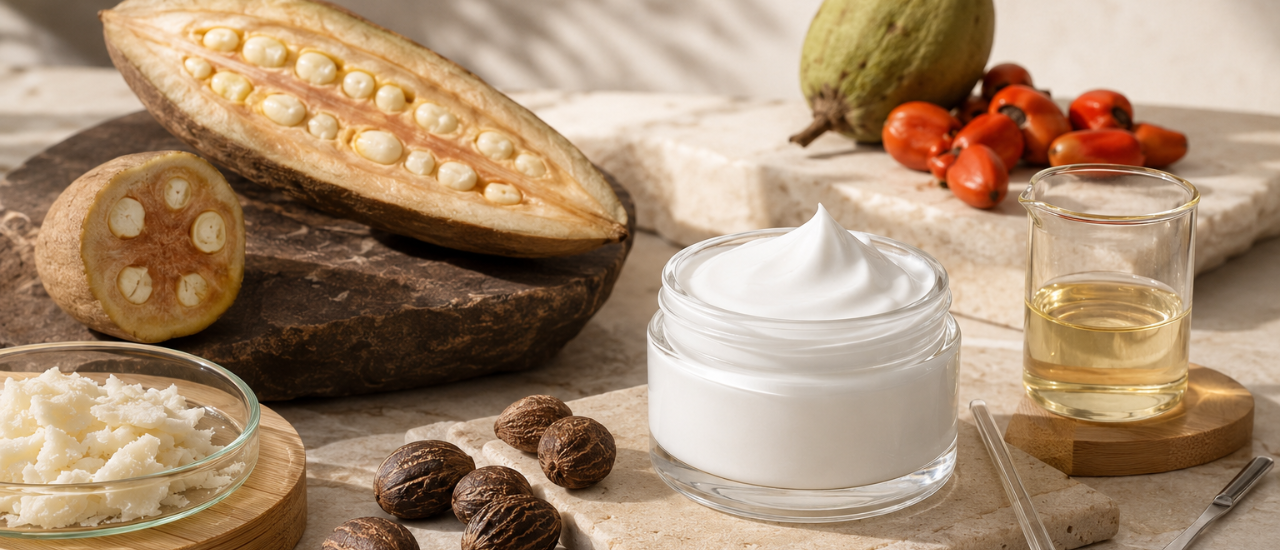
Effortless Natural Ingredient Research Library
Every material below is a candidate for literature review, supplier evaluation, bench experimentation, safety assessment, compatibility testing and eventual formula development.
Inclusion does not mean that an ingredient will necessarily appear in a finished product.
Note:
The scientific plant name is not necessarily the legal INCI ingredient name.
The final INCI will identify the exact commercial material, including the species, plant part and preparation: seed oil, kernel oil, flower extract, leaf extract, gum, hydrolyzed protein, fermented filtrate and so on.
1. Core African Botanical Research Candidates
| Common name | Scientific name | Materials to investigate | Research areas and potential roles |
|---|---|---|---|
| African baobab | Adansonia digitata L. | Flower, leaf, fruit polysaccharide, seed oil, possible seed protein | Slip, detangling, moisture films, lubrication, conditioning and repair research |
| Roselle hibiscus | Hibiscus sabdariffa L. | Flower or calyx extract, seed oil, polysaccharides, organic acids | Conditioning, shine, smoothing, film formation and antioxidant-support research |
| Okra | Abelmoschus esculentus (L.) Moench | Pod mucilage and polysaccharide fractions | High-slip detangling, water binding, rheology and film formation |
| Moringa | Moringa oleifera Lam. | Seed oil, leaf extract, possible protein hydrolysate | Emollience, gloss, scalp-oil systems and repair research |
| Marula | Sclerocarya birrea (A.Rich.) Hochst. | Kernel oil and fatty-acid derivatives | Glide, shine, finishing systems, lubrication and thermal-care research |
| Mafura | Trichilia emetica Vahl | Seed oil and butter | Intensive masks, pre-wash lubrication, balms and rich treatment systems |
| Mongongo / manketti | Schinziophyton rautanenii (Schinz) Radcl.-Sm. | Kernel oil | Lightweight finishing, gloss, anti-frizz and thermal-care systems |
| Kalahari melon | Citrullus lanatus (Thunb.) Matsum. & Nakai | Seed oil | Lightweight scalp oils, hair oils and fine-hair formulations |
| Ximenia | Ximenia americana L. or another verified Ximenia species | Seed oil | Coating, sealing, shine, lubrication and ends-protection research |
| Shea | Vitellaria paradoxa C.F.Gaertn. | Butter, oil fractions and esters | Rich conditioning, masks, creams, pre-wash products and structural lipids |
| Aloe ferox | Aloe ferox Mill. | Leaf gel, leaf-derived materials and seed oil | Hydration, scalp-comfort research, film formation and lightweight lipid support |
| Aloe vera | Aloe vera (L.) Burm.f. | Inner-leaf gel and polysaccharide fractions | Hydration, light glide, scalp serums and leave-in products |
| Allanblackia | Allanblackia floribunda Oliv. and related verified species | Seed fat | Balms, solid conditioners, butter systems and structuring lipids |
| Kombo / African nutmeg | Pycnanthus angolensis (Welw.) Warb. | Seed butter or oil | Rich treatments, scalp balms and specialty lipid research |
| Gum arabic tree | Senegalia senegal (L.) Britton | Gum exudate | Film formation, encapsulation, hold, product structure and delivery systems |
| Teff | Eragrostis tef (Zucc.) Trotter | Protein and peptide hydrolysates | Strengthening, amino-acid complexes, film formation and repair systems |
| Pearl millet | Cenchrus americanus (L.) Morrone | Grain protein and peptide fractions | Lightweight strengthening, repair treatments and thermal-care research |
| Sorghum | Sorghum bicolor (L.) Moench | Grain proteins and peptides | Repair, film formation, hold and thermal-protection research |
| Fonio | Digitaria exilis (Kippist) Stapf | Grain protein and peptide fractions | African repair-complex and amino-acid research |
| Cowpea | Vigna unguiculata (L.) Walp. | Protein and peptide fractions | Strengthening hydrolysates and conditioning research |
| Prickly pear | Opuntia ficus-indica (L.) Mill. | Seed oil and fruit extract | Lightweight oils, premium finishing and antioxidant-support research |
| Argan | Argania spinosa (L.) Skeels | Kernel oil | Shine, lubrication, softness and premium finishing |
| Buchu | Agathosma betulina (P.J.Bergius) Pillans and related verified species | Leaf extract and essential oil | Scalp and fragrance research, subject to sensitization controls |
| Cape chamomile | Eriocephalus punctulatus DC. | Essential oil | Fragrance, sensorial identity and aromatic research |
| African geranium | Pelargonium graveolens L’Hér. or a verified cultivated species or hybrid | Essential oil | Fragrance research unless further functionality is substantiated |
| Frankincense | Boswellia sacra Flueck. and other verified Boswellia species | Resin, extract and essential oil | Fragrance, scalp-comfort and botanical research |
| Myrrh | Commiphora myrrha (Nees) Engl. | Resin and extract | Fragrance and botanical research |
| African basil | Exact species to be selected; potentially Ocimum gratissimum L. | Leaf extract and essential oil | Scalp and fragrance research |
| Lemongrass | Cymbopogon citratus (DC.) Stapf | Essential oil and extract | Fragrance, cleansing concepts and scalp research, with sensitization controls |
Species-Verification Note
Names such as Adansonia digitata, Abelmoschus esculentus and Vitellaria paradoxa identify the plant species. The final material must still be verified against:
- supplier documentation;
- country of origin;
- plant part;
- extraction method;
- processing;
- purity;
- final INCI name.
2. Broader Botanical and Oil Research Candidates
These materials may support an Africa-rooted platform without necessarily being exclusively African in origin.
| Common name | Scientific name | Materials to investigate | Research areas and potential roles |
|---|---|---|---|
| Sunflower | Helianthus annuus L. | Seed oil and derivatives | Carrier oils, linoleic-rich blends, scalp oils and pre-wash systems |
| Coconut | Cocos nucifera L. | Kernel oil and derivatives | Pre-wash penetration, lubrication and protein-loss research |
| Avocado | Persea americana Mill. | Fruit or pulp oil | Rich conditioning, lubrication and mask systems |
| Jojoba | Simmondsia chinensis (Link) C.K.Schneid. | Seed wax ester | Stable scalp oils, lightweight finishing and sebum-inspired systems |
| Castor | Ricinus communis L. | Seed oil and derivatives | Viscous sealing, shine, hold and styling blends |
| Jamaican black castor oil | Ricinus communis L. | Roasted or processed castor oil | Provenance, processing and performance comparison with conventional castor oil |
| Sesame | Sesamum indicum L. | Seed oil | Carrier oils, antioxidant-rich blends and lubrication |
| Poppy | Papaver somniferum L. | Seed oil | Lightweight shine and finishing research |
| Passion fruit / maracuja | Usually Passiflora edulis Sims | Seed oil | Lightweight emollience, shine and fine-hair applications |
| Mango | Mangifera indica L. | Seed butter | Creams, masks, balms and structural lipid systems |
| Cocoa | Theobroma cacao L. | Seed butter | Structure, occlusion, rich masks and balm systems |
| Tamanu | Calophyllum inophyllum L. | Seed oil | Specialty scalp and oil research; color, odor and sensitization require review |
| Tamarind | Tamarindus indica L. | Seed polysaccharides and extracts | Water retention, film formation, conditioning and texture systems |
| Jujube | Usually Ziziphus jujuba Mill. | Fruit, seed or botanical extract | Scalp-oriented research, subject to supplier-material verification |
| Maca | Lepidium meyenii Walp. | Root-derived cosmetic extract | Density-positioning and scalp-product research, without unsupported growth claims |
| Rice | Oryza sativa L. | Fermented filtrate, water, peptides, proteins, starch and amino-acid materials | Smoothing, conditioning, strengthening and sensorial research |
| Apple | Malus domestica (Suckow) Borkh. | Fermented juice or vinegar source material | Acidic rinses, pH systems and clarifying research |
| Grape | Vitis vinifera L. | Seed oil and fruit or skin extract | Lightweight oils and antioxidant-support research |
| Turmeric | Curcuma longa L. | Root extract and derivatives | Scalp-wellness and antioxidant research; staining and compatibility require testing |
| Acerola | Malpighia emarginata DC. | Fruit extract | Vitamin-C-rich botanical and antioxidant-support research |
| Coriander | Coriandrum sativum L. | Seed or leaf extract | Botanical and scalp research |
| Black seed | Nigella sativa L. | Seed oil and extract | Scalp, lipid and antioxidant research |
| Fenugreek | Trigonella foenum-graecum L. | Seed mucilage, protein and extract | Slip, conditioning, protein and traditional-haircare research |
| Rosemary | Salvia rosmarinus Spenn. | Leaf extract and essential oil | Scalp and fragrance research; formerly Rosmarinus officinalis |
| Tea tree | Melaleuca alternifolia (Maiden & Betche) Cheel | Leaf essential oil | Scalp-cleansing and fragrance research, with sensitization controls |
Cultural-Origin Note
Fenugreek and black seed belong more appropriately to a broader Afro-Arab, Mediterranean and Ayurvedic ingredient library than to a strictly African-origin platform.
They may still be researched, but their origin and cultural positioning should be represented accurately.
3. Botanical Polymers, Waxes and Styling Materials
| Material | Scientific source | Form to investigate | Research areas and potential roles |
|---|---|---|---|
| Myrica wax | Often Morella cerifera (L.) Small, formerly Myrica cerifera | Plant wax | Soft hold, curl definition, balm structure and styling-product texture |
| Baobab-derived polysaccharide | Adansonia digitata | Flower, fruit or other verified polysaccharide material | Slip, detangling, film formation and moisture retention |
| Okra mucilage | Abelmoschus esculentus | Pod-derived mucilage or purified polysaccharide | Detangling glide, rheology, hold and water binding |
| Hibiscus polysaccharide | Hibiscus sabdariffa, subject to material verification | Flower or calyx-derived polysaccharide | Conditioning, film formation and styling research |
| Aloe polysaccharides | Aloe vera or Aloe ferox | Purified gel or polysaccharide fractions | Hydration, lightweight films and scalp-serum texture |
| Gum arabic | Primarily Senegalia senegal and Vachellia seyal | Gum exudate | Film formation, light hold, encapsulation and formula structure |
4. Grain, Protein and Peptide Research Platform
Rather than treating “protein” as a single ingredient category, Effortless investigates how the source, molecular weight and hydrolysis process affect performance.
| Source | Scientific name | Candidate material | Research questions |
|---|---|---|---|
| Teff | Eragrostis tef | Hydrolyzed teff protein or peptides | Can it improve film formation, feel, flexibility or temporary strength without excessive stiffness? |
| Pearl millet | Cenchrus americanus | Hydrolyzed grain protein or peptides | Can it support lightweight strengthening for fine or easily coated hair? |
| Sorghum | Sorghum bicolor | Hydrolyzed protein or peptide fractions | Can it support repair, hold or thermal-care systems? |
| Fonio | Digitaria exilis | Hydrolyzed fonio protein or peptides | Can it become part of an African grain repair complex? |
| Cowpea | Vigna unguiculata | Hydrolyzed seed protein or peptides | Can it provide useful conditioning or fibre reinforcement? |
| Baobab | Adansonia digitata | Possible seed protein or hydrolysate | Can baobab contribute beyond oils and polysaccharides? |
| Moringa | Moringa oleifera | Possible seed or leaf protein hydrolysate | Can it contribute to strengthening or conditioning systems? |
| Rice | Oryza sativa | Hydrolyzed rice protein, amino acids or fermented filtrate | How does it perform relative to African grain alternatives? |
The testing should consider:
- molecular weight;
- deposition;
- stiffness;
- flexibility;
- wet and dry combing;
- breakage;
- repeated-use buildup;
- porosity;
- interaction with cationic conditioners;
- suitability across textures.
5. Non-Botanical and Processed Technical Materials
These materials do not have botanical scientific names, even where the manufacturing feedstock may be plant-derived.
| Ingredient or material | Technical identity | Research areas and potential roles |
|---|---|---|
| Hyaluronic acid | Hyaluronan or sodium hyaluronate | Hydration, film formation and scalp-serum research |
| “Plant collagen” | Marketing term usually referring to plant proteins, amino acids or polysaccharides | Film formation and moisturization; exact material must be identified |
| Vegetable glycerin | Glycerol | Humectancy, solvent function and water-activity management |
| Caprylic/capric triglyceride | Medium-chain triglyceride ester | Lightweight carrier, spreadability and sensorial improvement |
| Squalane | Hydrogenated squalene, plant- or biotech-derived | Lightweight emollience and finishing |
| Tocopherol | Vitamin E | Oxidative stability of oils and antioxidant support |
| Ceramides | Sphingolipid family | Fibre-lipid, cuticle and conditioning research |
| Phytoceramides | Plant-derived ceramide materials | Lipid-recovery and repair-system research |
| Hydrolyzed proteins | Enzymatically or chemically reduced proteins | Temporary fibre reinforcement, film formation and conditioning |
| Amino acids | Individual or blended amino-acid materials | Strengthening mists, hydration systems and fibre-conditioning research |
| Cationic conditioners | Examples include behentrimonium chloride and behentrimonium methosulfate | Wet slip, reduced combing force, deposition and softness |
| Fatty alcohols | Cetyl, cetearyl and behenyl alcohol | Conditioner structure, softness, viscosity and deposition |
| Conditioning polymers | Polyquaterniums, cationic guar and related polymers | Slip, anti-static performance, detangling and deposition |
| Styling polymers | Natural, synthetic or hybrid film formers | Curl definition, hold, humidity resistance and style longevity |
| Apple-cider vinegar | Fermented acetic-acid solution | Low-pH rinses, clarification and scalp-product research |
| Fermented rice water | Rice-derived fermented filtrate | Smoothing and strengthening-positioning research |
| Fragrance materials | Mixed aromatic composition | Sensory identity, with IFRA, allergen and sensitization review |
| Preservative systems | Cosmetic antimicrobial systems | Formula safety and microbiological stability |
| Chelating agents | Materials that bind metal ions | Hard-water performance, stability and cleansing support |
| pH adjusters | Acids, bases and buffer systems | Formula stability, fibre compatibility and preservative performance |
| Surfactants | Anionic, amphoteric, nonionic and cationic cleansing materials | Cleansing performance, mildness, foam and deposition |
| Emulsifiers | Materials that stabilize oil-and-water systems | Stability, texture, delivery and sensorial performance |
| Rheology modifiers | Natural or synthetic thickeners | Flow, suspension, application and stability |
Preservation, chelation, surfactants, emulsification and pH control are not secondary details. They are part of what makes a botanical formulation safe, reproducible and scientifically credible.
6. Proposed First Research Platform
The original shortlist remains strong, but it should now be presented as the first research platform, not the final ingredient system.
African Botanical Foundation
- Adansonia digitata — baobab flower, leaf, fruit, seed oil and possible seed protein
- Abelmoschus esculentus — okra mucilage
- Hibiscus sabdariffa — roselle hibiscus
- Moringa oleifera — moringa
- Sclerocarya birrea — marula
- Trichilia emetica — mafura
- Aloe ferox — African aloe
- Schinziophyton rautanenii — mongongo
- Citrullus lanatus — Kalahari melon
- Ximenia species — exact species to be confirmed
- Vitellaria paradoxa — shea
African Grain and Repair Platform
- Eragrostis tef — teff
- Cenchrus americanus — pearl millet
- Sorghum bicolor — sorghum
- Digitaria exilis — fonio
- Vigna unguiculata — cowpea
Supporting Technical Platform
- Cationic conditioning agents
- Fatty alcohols
- Conditioning and styling polymers
- Ceramides or phytoceramides
- Hydrolyzed proteins and amino acids
- Humectants
- Lightweight esters and emollients
- Chelators, preservatives and pH systems
7. How Each Candidate Should be Evaluated
Every ingredient should move through the same research process.
| Research stage | Key question |
|---|---|
| Historical and cultural review | How has this material traditionally been used, by whom and in what context? |
| Scientific literature review | What evidence exists for the raw material, plant part or chemical composition? |
| Supplier verification | What exact species, origin, extraction method and INCI are being supplied? |
| Composition analysis | What fatty acids, proteins, polysaccharides, minerals or phytochemicals characterize it? |
| Safety review | What irritation, sensitization, toxicity or allergen concerns must be considered? |
| Bench formulation | How does it behave in shampoos, conditioners, oils, creams, masks, mists or styling products? |
| Compatibility testing | Does it destabilize emulsions, preservation systems, fragrances or active materials? |
| Instrumental testing | What measurable effect does it have on combing force, breakage, friction, gloss, hold or moisture behaviour? |
| Sensory testing | How does it affect slip, residue, weight, tack, scent, spread and rinseability? |
| Texture-spectrum testing | How does performance vary by curl pattern, strand diameter, density, porosity and styling routine? |
| Stability and microbiology | Does the complete formula remain safe and stable over time? |
| Claims substantiation | What can the final product truthfully and legally claim? |
8. Recommended Research-Status Language
To prevent the website or app from implying that every ingredient is already proven or included in a product, each material can have a visible status.
- Research Candidate — under initial investigation
- Literature Review — scientific and traditional evidence being assessed
- Supplier Review — sourcing and commercial materials being evaluated
- Bench Testing — being tested in prototype formulas
- Performance Testing — complete formulas being compared
- Selected for Development — approved for further product work
- Formula Confirmed — included in a finalized formula
- Not Progressed — investigated but not selected
That gives MOYO room to document the journey honestly.
9. Website and App Display Architecture
For the educational layer:
Adansonia digitata
AFRICAN BAOBAB
Flower · Leaf · Fruit · Seed
Malawi and wider sub-Saharan Africa
Slip · Detangling · Lipid · Protein research
Research status: Candidate library
The accompanying copy could say:
We are investigating multiple baobab-derived materials, including seed oil, flower and fruit extracts, polysaccharides and possible protein fractions. Their inclusion in the research library does not mean that every form will appear in a finished formula.
For the regulated ingredient declaration, the eventual INCI may instead read:
Adansonia Digitata Seed Oil
or
Adansonia Digitata Fruit Extract
or
Adansonia Digitata Flower Extract
Those are separate cosmetic materials and should never be treated as interchangeable.
10. The Principle Governing the Library
A useful statement for the brand bible:
Effortless Natural maintains a living ingredient research library spanning African botanicals, diasporic haircare traditions and modern cosmetic technologies. Inclusion in the library represents an intention to investigate—not a predetermined conclusion about performance or suitability. Every ingredient must earn its role through evidence, responsible sourcing, formulation compatibility, safety assessment and testing of the complete product.